Terahertz

Terahertz

The Terahertz team aims to tackle disruptive challenges in terahertz components and systems in order to meet emerging industrial and societal needs. Its approach is structured as an integrated framework, spanning from breakthrough photonic and electronic components—where technological disruptions are anticipated—to the development of complete THz systems.

Our team contributes to:

  • The application oriented holistic THz systems design
  • Passive mmW & THz component design and testing
  • mmW & THz SiGe HBT Transistor architecture optimization, characterization and modelling
  • Nondestructive testing with mmW and THz pulse and radar technologies
  • THz Computational imaging platform
  • Innovative photonics-based THz sources and its integration
  • Integrated circuit laser test and fault injection

The societal impact of terahertz technologies is one of the recognized strengths of our team. A key challenge will be to reassess existing applications in light of the new opportunities enabled by recent technological breakthroughs in the terahertz domain.

Read more

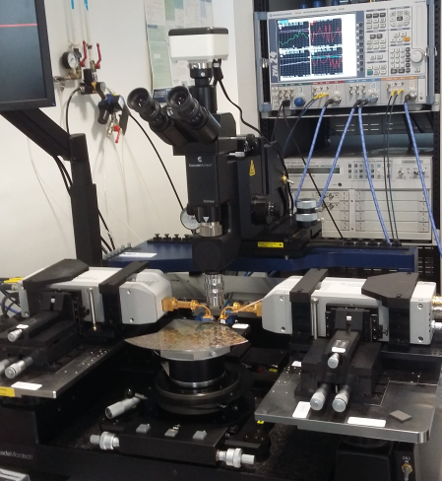
Probe station and network analyser operating up to 750 GHz for on-wafer characterization.

THEME 1: mmW & THz transistor architecture optimization, characterization and modelling

The objectives focus on the development of silicon-based THz applications. Recent advances in silicon transistor technologies have opened new opportunities for the design of compact and low-cost THz circuits and systems. Among the available technologies, BiCMOS offers a particularly attractive trade-off between sensitivity, cost, and functionality.

To achieve these objectives in silicon-based THz applications, our team contributes through:
• The development of novel SiGe HBT architectures optimized for THz performance
• The development of high-frequency measurement methodologies for on-wafer S-parameter characterization up to 750 GHz, including:
• The evaluation of new calibration procedures and the definition of dedicated calibration standards
•  Electromagnetic simulation and calibration of high-frequency probe coupling
• The design of new probes for millimeter-wave measurements
• Very-high-frequency and electro-thermal modeling of SiGe HBT devices.

 Examples of recent or on-going projects:  SHIFT (link1 or link2), ANR PRECISE (link), IPCEI TRAVEL

THEME 2: THz Computational imaging platform


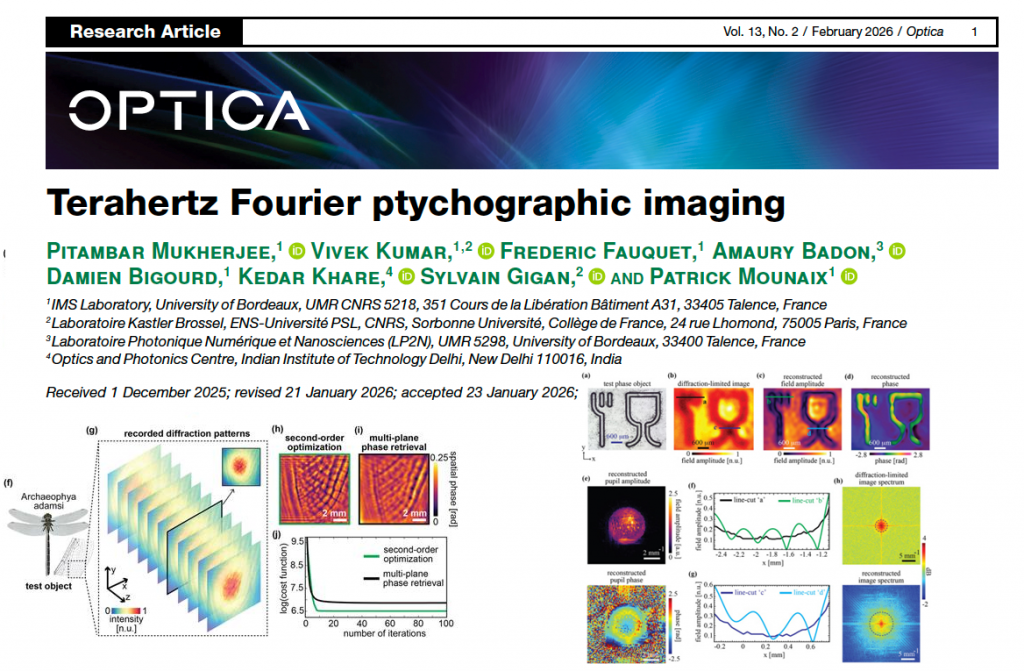
The research focuses on computational terahertz imaging, where fast, indirect measurements are converted into 2D/3D images and phase maps using reconstruction algorithms. This work is at the interface of THz instrumentation and inverse problems, combining measurement design with physics-informed reconstruction. A core objective is to recover more than raw intensity, including depth, internal structure, and material contrast. Computational phase retrieval is central to the activity, enabling complex-field imaging without heavy interferometric setups. By using intensity measurements taken under controlled propagation conditions, we can reconstruct phase and amplitude jointly. This provides sharper reconstructions and improves sensitivity to small defects or weakly contrasted interfaces. We also work on 3D rendering and automated interpretation, so that volumetric THz data can be exploited efficiently. Across projects, the guiding principle is to simplify experiments and shift complexity to reliable algorithms. The methods aim for high-throughput operation, reproducibility, and transfer to real inspection constraints.

Non-destructive testing is a major application motivation, especially for low-loss dielectrics such as polymers and composite materials (Art Science and industry, etc). We develop end-to-end processing pipelines to turn THz data into actionable information for inspection and metrology. These pipelines typically include denoising, calibration, segmentation, and quantitative feature extraction. Another important direction is accelerating acquisition while maintaining image quality and robustness. To that end, we explore illumination and scanning strategies that improve signal-to-noise ratio and limit coherence-related artifacts.

Examples of recent or on-going projects :  ANR HYPSTER (link), COMPTERA-PEPR ELECTRONIQUE (link), NRA TERANANOPORES 


THEME 2: THz Computational imaging platform

The research focuses on computational terahertz imaging, where fast, indirect measurements are converted into 2D/3D images and phase maps using reconstruction algorithms. This work is at the interface of THz instrumentation and inverse problems, combining measurement design with physics-informed reconstruction. A core objective is to recover more than raw intensity, including depth, internal structure, and material contrast. Computational phase retrieval is central to the activity, enabling complex-field imaging without heavy interferometric setups. By using intensity measurements taken under controlled propagation conditions, we can reconstruct phase and amplitude jointly. This provides sharper reconstructions and improves sensitivity to small defects or weakly contrasted interfaces. We also work on 3D rendering and automated interpretation, so that volumetric THz data can be exploited efficiently. Across projects, the guiding principle is to simplify experiments and shift complexity to reliable algorithms. The methods aim for high-throughput operation, reproducibility, and transfer to real inspection constraints.

Non-destructive testing is a major application motivation, especially for low-loss dielectrics such as polymers and composite materials (Art Science and industry, etc). We develop end-to-end processing pipelines to turn THz data into actionable information for inspection and metrology. These pipelines typically include denoising, calibration, segmentation, and quantitative feature extraction. Another important direction is accelerating acquisition while maintaining image quality and robustness. To that end, we explore illumination and scanning strategies that improve signal-to-noise ratio and limit coherence-related artifacts.

Examples of recent or on-going projects:  ANR HYPSTER (link), COMPTERA-PEPR ELECTRONIQUE (link), NRA TERANANOPORES

Sub-The Fully-Metallic Geodesic Luneburg Lens Antenna

THEME 3: THz Passive components


The continued increase in operational frequencies toward the THz range will require the development of a complete ecosystem of passive components, similar to those available in optics and microwave engineering, in order to design fully integrated THz systems. Some of these components may emerge as scaled extensions of well-established concepts from other regions of the electromagnetic spectrum, although such scaling introduces significant technological and physical challenges. Other functionalities, however, will necessitate the development of entirely new devices specifically adapted to the THz domain.

Two short-term research directions can be highlighted. The first concerns the development of terahertz waveguides. This includes, on the one hand, waveguide-based sensing platforms, where strong field confinement enhances light–matter interaction, and on the other hand, infrared (IR) waveguides designed to enable efficient IR–THz coupling schemes. Such hybrid approaches could facilitate compact and efficient THz generation, manipulation, and detection.

The second example involves the development of Luneburg antennas operating in the THz range. These devices offer promising prospects for higher-frequency operation and could contribute to emerging applications such as sixth-generation (6G) wireless communications and high-resolution radar-based detection systems.

Examples of recent or on-going projects :  ESA DROPLENS

Sub-THz Fully-Metallic Geodesic Luneburg Lens Antenna

THEME 3: THz Passive components

The continued increase in operational frequencies toward the THz range will require the development of a complete ecosystem of passive components, similar to those available in optics and microwave engineering, in order to design fully integrated THz systems. Some of these components may emerge as scaled extensions of well-established concepts from other regions of the electromagnetic spectrum, although such scaling introduces significant technological and physical challenges. Other functionalities, however, will necessitate the development of entirely new devices specifically adapted to the THz domain.

Two short-term research directions can be highlighted. The first concerns the development of terahertz waveguides. This includes, on the one hand, waveguide-based sensing platforms, where strong field confinement enhances light–matter interaction, and on the other hand, infrared (IR) waveguides designed to enable efficient IR–THz coupling schemes. Such hybrid approaches could facilitate compact and efficient THz generation, manipulation, and detection.

The second example involves the development of Luneburg antennas operating in the THz range. These devices offer promising prospects for higher-frequency operation and could contribute to emerging applications such as sixth-generation (6G) wireless communications and high-resolution radar-based detection systems.

Examples of recent or on-going projects:  ESA DROPLENS

Typical optical and THz set-ups

THEME 4 : THz Photonic

  • Another major research axis concerns the design and fabrication of photonics-based THz sources and systems. THz devices—including sources, detectors, and integrated subsystems—are primarily developed using nonlinear optical processes in various materials, photoconductive approaches, or by engineering the temporal and spectral properties of the incident laser pulses. Our research strategy spans from advanced numerical simulations to experimental validation, with the objective of achieving laboratory-scale proof of concept. The main goals are to enhance key system performance metrics, including conversion efficiency, output power, and spectral bandwidth—particularly toward the far-infrared region. In addition, we aim to tailor the spatial profile of the generated THz field, for instance through structured waveguide networks or modal engineering approaches. A significant effort is also devoted to the investigation of different waveguide platforms for THz radiation. These structures enable efficient confinement of the THz field for targeted applications, as well as improved generation and detection schemes within integrated waveguide geometries.
  • Optical and THz pulses can also be employed for fault injection in the evaluation of the robustness and security of electronic circuits and components. In this context, laser or THz radiation is directed at specific regions of a chip to induce controlled perturbations and analyze the system’s response. Several complementary techniques are used:  1)A pump laser or THz pulse disrupts the normal operation of the circuit by generating free carriers or localized perturbations; 2) An optical probe beam is analyzed after transmission through the substrate and reflection at internal interfaces, without disturbing the device operation; 3) A first pump pulse induces a controlled modification in the circuit, while a second optical or THz probe pulse monitors the resulting changes, enabling time-resolved analysis of the induced effects. These approaches provide powerful tools for studying device reliability, identifying vulnerabilities, and characterizing the dynamic response of electronic systems under electromagnetic perturbation.

Examples of recent or on-going projects : ANR TERAPPY


THEME 4: THz Photonic

  • Another major research axis concerns the design and fabrication of photonics-based THz sources and systems. THz devices—including sources, detectors, and integrated subsystems—are primarily developed using nonlinear optical processes in various materials, photoconductive approaches, or by engineering the temporal and spectral properties of the incident laser pulses. Our research strategy spans from advanced numerical simulations to experimental validation, with the objective of achieving laboratory-scale proof of concept. The main goals are to enhance key system performance metrics, including conversion efficiency, output power, and spectral bandwidth—particularly toward the far-infrared region. In addition, we aim to tailor the spatial profile of the generated THz field, for instance through structured waveguide networks or modal engineering approaches. A significant effort is also devoted to the investigation of different waveguide platforms for THz radiation. These structures enable efficient confinement of the THz field for targeted applications, as well as improved generation and detection schemes within integrated waveguide geometries.
  • Optical and THz pulses can also be employed for fault injection in the evaluation of the robustness and security of electronic circuits and components. In this context, laser or THz radiation is directed at specific regions of a chip to induce controlled perturbations and analyze the system’s response. Several complementary techniques are used:  1)A pump laser or THz pulse disrupts the normal operation of the circuit by generating free carriers or localized perturbations; 2) An optical probe beam is analyzed after transmission through the substrate and reflection at internal interfaces, without disturbing the device operation; 3) A first pump pulse induces a controlled modification in the circuit, while a second optical or THz probe pulse monitors the resulting changes, enabling time-resolved analysis of the induced effects. These approaches provide powerful tools for studying device reliability, identifying vulnerabilities, and characterizing the dynamic response of electronic systems under electromagnetic perturbation.

Examples of recent or on-going projects: ANR TERAPPY

Typical optical and THz set-ups

Terahertz skills

On wafer S parameter characterization of passive devices and transistors up to the THz range

TCAD and compact modelling of SiGe HBT

Passive mmW and THz device design and development

Time-Domain Spectroscopy and imaging : development and analysis

Tomography and ptychography

Radar and SAR techniques with mm and sub mm waves

Design and development of THz sources and detectors

Non-linear optics serving optical and THz sources and detector  : Conception, Simulation, Experiment

For the various research projects underway, the IMS Bordeaux laboratory and its teams rely on strong partnerships and collaborations, which allow for the creation of a synergy of strengths and a sharing of technical and human resources

Collaborations and partners

ENS-Logo
LP2N-logo
CEA-Logo
IEMN_Logo
IES_logo
L2C_logo
XLIM-logo
Femto-st_logo

Partners

News

Latest news from the team

THESIS DEFENSE of Gabriel TATON - December 10, 2025

Gabriel TATON will defend his thesis on December 10, 2025 at 2:00 pm in the amphitheater JP. DOM of the IMS Laboratory, on the subject: “THz spectroscopy by photo-mixing of optical chirped pulses on photo-conductive antennas”.

THESIS DEFENSE of Ilyes BETKA - December 2, 2025

Ilyes BETKA will defend his thesis on December 2, 2025 at 2:00 pm in the amphitheater JP. DOM of the IMS Laboratory, on the subject: “Second order nonlinear optical process in THz waveguides”.

HDR DEFENSE of Jean-Paul GUILLET - November 28, 2025

Jean-Paul GUILLET will defend his HDR on November 28, 2025 at 10:00 am in the amphitheater JP. DOM of the IMS Laboratory, on the subject: “Matter analysis with terahertz waves: from components and systems to applications”.

The IMS Laboratory at CLEO Europe 2025: Award Recognition for Terahertz Imaging Research

Members of the IMS Laboratory’s Terahertz team (Waves research group) presented two significant contributions at CLEO Europe 2025, held in June in Munich, Germany. This work earned Pitambar Mukherjee the Young Minds Best Student Presentation Award!

Research spotlight: Sub-THz Fully-Metallic Geodesic Luneburg Lens Antenna 

A new design demonstrating the robustness of geodesic lenses in the sub-THz regime; showing their suitability for applications that require multi-beam antennas at these high frequencies.

Research spotlight: Fourier synthetic-aperture-based time-resolved terahertz imaging

A new THz imaging approach overcoming the diffraction limit by acquiring high-spatial-frequency components using a Fourier synthetic aperture.

Members

Staff

Meet the members of the research team

Zeinab ABDUL HADI
Damien BIGOURD
Philippine BILLY
Tarek BOUZAR
Dyune CARON
Frédéric DARRACQ
Abhishek ENATHAYIL VADAKKEKALAM SHAJI
Frédéric FAUQUET
Sébastien FREGONESE
Jean-Paul GUILLET
Vivek KUMAR
Dean LEWIS
Peiliang LIU
Patrick MOUNAIX
Pitambar MUKHERJEE
Arnab SAHA
Raphaël STRENAER
Thomas ZIMMER
Résumé en français

L’équipe Térahertz vise à relever des défis disruptifs dans les composants et les systèmes térahertz afin de répondre aux besoins industriels et sociétaux émergents. Son approche est structurée, allant des composants photoniques et électroniques de rupture — où des avancées technologiques majeures sont attendues — jusqu’au développement de systèmes THz complets.

Notre équipe contribue à :

  • La conception holistique de systèmes THz orientée application

  • La conception et les tests de composants passifs en ondes millimétriques (mmW) et térahertz (THz)

  • L’optimisation de l’architecture, la caractérisation et la modélisation des transistors SiGe HBT pour les fréquences mmW et THz

  • Le contrôle non destructif utilisant des impulsions et des technologies radar en ondes millimétriques et térahertz

  • Le développement de plateformes d’imagerie computationnelle THz

  • Les sources THz innovantes basées sur la photonique et leur intégration

  • Les tests de lasers en circuits intégrés et l’injection de défauts

L’impact sociétal des technologies térahertz constitue l’une des forces reconnues de notre équipe. Un défi majeur consistera à réévaluer les applications existantes à la lumière des nouvelles opportunités offertes par les récentes avancées technologiques dans le domaine des térahertz.

Contact our team

If you have a request or questions about the laboratory, please contact our team.