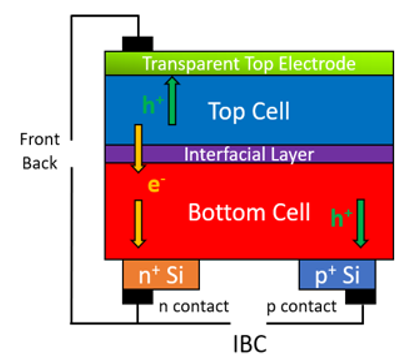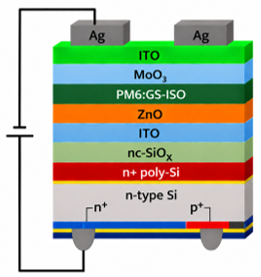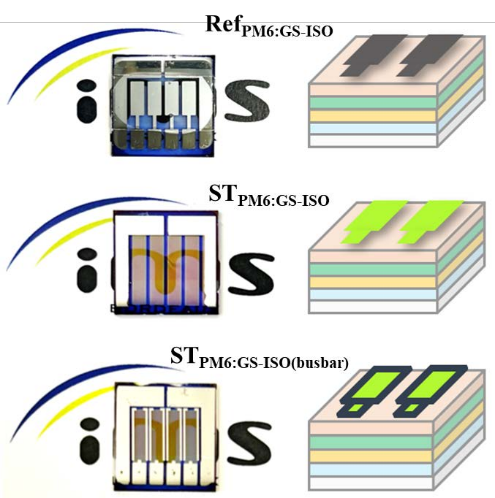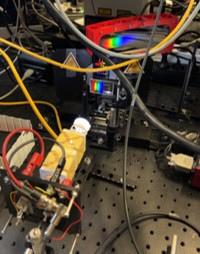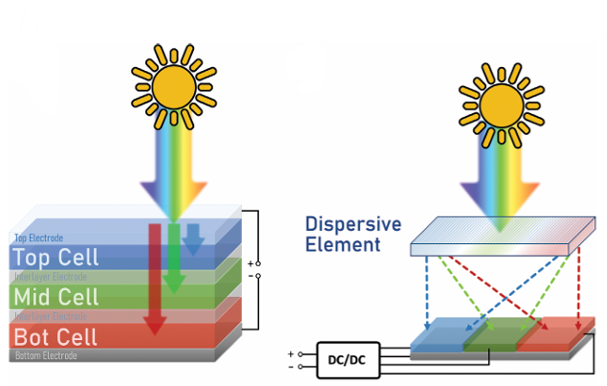


Photovoltaics is now a mature technology, largely dominated by crystalline silicon, but single-junction devices are approaching their theoretical efficiency limit. Tandem architectures offer a promising solution by combining materials with complementary bandgaps to reduce thermalization losses. In particular, silicon-based tandems combine the maturity of silicon technology with wide-bandgap top cells. Organic photovoltaics are attractive for this application thanks to their tunable bandgaps, strong absorption and compatibility with low-cost processing. This thesis therefore focuses on the integration of a wide-bandgap semi-transparent OPV top cell with an IBC silicon bottom cell in a three-terminal architecture. The OPV was optimized using the PM6:GS-ISO blend, reaching efficiencies around 10 % with a high VOC of 1.20 V. A room-temperature sputtered ITO electrode was then developed to obtain semi-transparent OPV devices with efficiencies close to 6 %. These developments enabled the technological integration of the OPV and IBC silicon cells in a 3T configuration. Finally, the RAINBOW concept was investigated as an alternative lateral OPV/Si architecture combining experimental measurements and optical modeling.