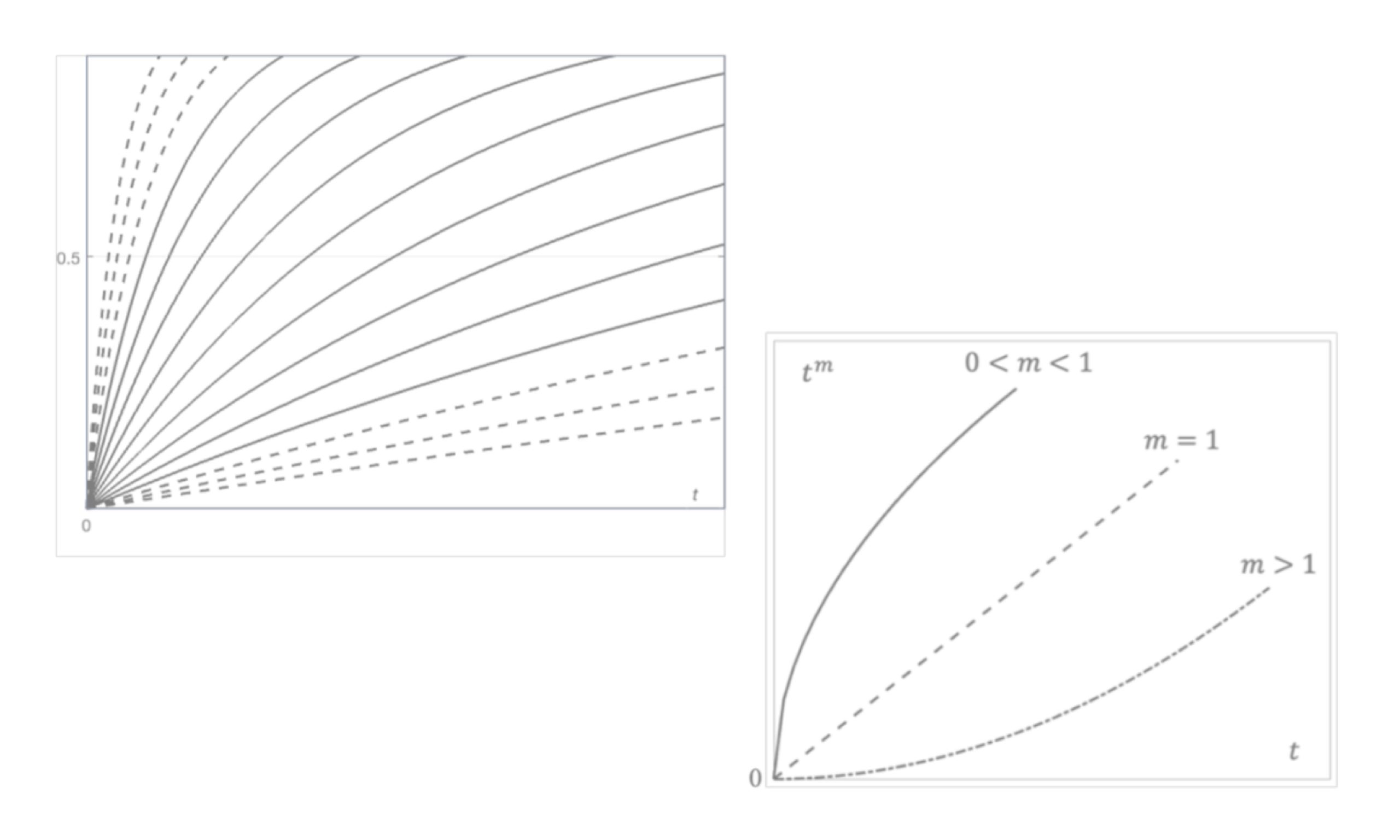


The FPM (Fractional Power Model) is a three-parameter power-law model. It is a unified, simple, and predictive model that uses past data to better predict the future.
The model is highly promising due to its representativity—which stems from its internal complexity—and its remarkable predictive ability, governed by a single power of time.
A Unified Representation of Complex Dynamics
When studying complex phenomena such as a viral propagation, in which infections occur at different rates (from rare to frequent) and in different numbers (from low to high), there is an unlimited number of internal dynamics operating at different rates. Each of these dynamics therefore constitutes a component of the phenomenon’s overall dynamics.
The phenomenon can consequently be defined, up to a multiplicative factor, by the power-law 𝑡 𝑚, where 𝑚 is a non-integer power.
In the FPM model, this power-law is completed by two constants:
- an additive constant, A, which accounts for everything accumulated before the initial time, 𝑡 = 0 , from which point onward the evolution follows a power-law;
- and a multiplicative constant, B, as a factor of 𝑡 𝑚, since the overall dynamics in power-law is defined by 𝑡 𝑚 up to a multiplicative factor.
Thus, a simple and unified representation capable of accurately capturing complexity takes the form of the function A + B 𝑡 𝑚.
In particular, this function makes it possible to easily visualize, in graphical form, the progression, stagnation, or regression of the phenomenon under study over time through curves.
Advantages of the FPM Model
The FPM model offers several advantages:
- It is free from any prior hypotheses, since its parameters are calculated using actual historical data, which then condition the model and its predictions;
- It retains a single power of time, 𝑡 𝑚, which ensures consistent behavior at all times, both over short and long time scales;
- It demonstrates high accuracy, with only very low error percentages.
Enhanced by a long-memory predictive form, the model shows that any future (or predicted) value is a weighted function of all past values.
Many changes in the evolution of the phenomena under study can therefore be part of a continuity of prior changes that are less significant, or even imperceptible, yet sufficient to affect the data used to calculate the model during the identification phase.
Moreover, for particularly long prediction horizons, the FPM model proves to be considerably more efficient than models of comparable complexity and at least as efficient as the most complex models, while requiring fewer computational resources due to its structural simplicity.
A Common Framework for Complex Phenomena
The FPM model is a model whose overall simplicity represents its internal complexity that exhibits precisely the type of internal dynamics unifying complexity.
In this respect, it embodies a unification of complexity that can be readily and broadly applied to complex phenomena, such as infections, vaccinations, atmospheric CO₂ concentration, air and water temperature, mean sea level, or a country’s debt. Alain Oustaloup has tested and validated his model using all these phenomena.
The approach can therefore be extended to complex phenomena of different kinds simply by analyzing their internal dynamics through the cumulative quantities associated with the phenomena under study.
The unlimited number of internal dynamics operating at different rates thus constitutes the common denominator of all these complex phenomena.
This makes the FPM model a valuable predictor for decision-makers.
Biography
A graduate of ENSEIRB in 1973, Alain Oustaloup is currently Professor Emeritus at ENSEIRB-MATMECA – Bordeaux INP and continues to conduct research at the IMS Laboratory.
After synthesizing the complex non-integer differentiation or integration, then overcoming the stability-accuracy dilemma in automatic control and the mass-damping dilemma in mechanics, he invented the CRONE control and the CRONE suspension.
More recently, he has once again broken new ground with the FPM model presented here.
His work has been recognized with the French National Centre for Scientific Research (CNRS) Silver Medal in 1997 and the Grand Prize of the French Academy of Sciences in 2011.
Detail
https://hal.science/hal-05700939v1
Alain Oustaloup, François Levron, Stéphane Victor, Luc Dugard. The FPM model, a prediction model for the most diverse complex phenomena. 2026. ⟨hal-05700939⟩
Abstract
Recognized as a “CNRS 2021 highlight” and distinguished by its predictions for complex phenomena of a different nature (contaminations, vaccinations, CO₂, temperature, mean sea level, France’s debt, …), the FPM (Fractional Power Model), in power-law and with three parameters, is unified thanks to a unification of complexity, simple due to its overall representation of complexity and predictive because of its ability to make the best use of the past to better predict the future, making it a good predictor for decision-makers.


