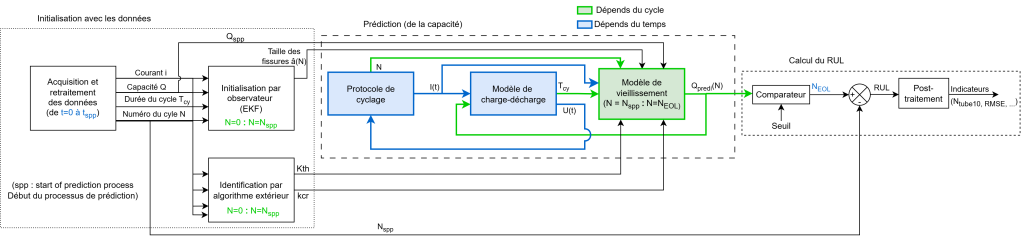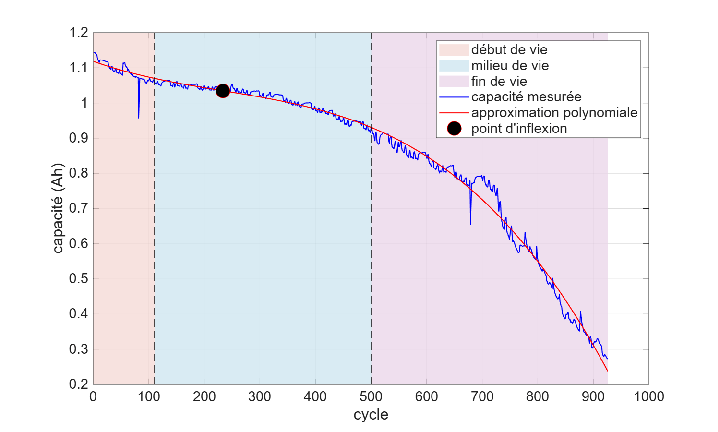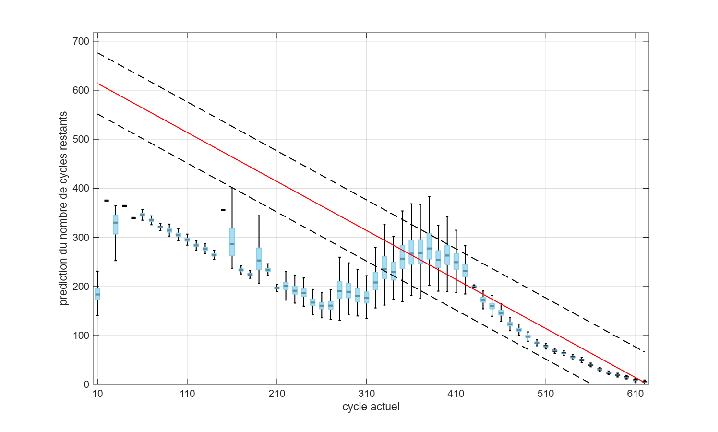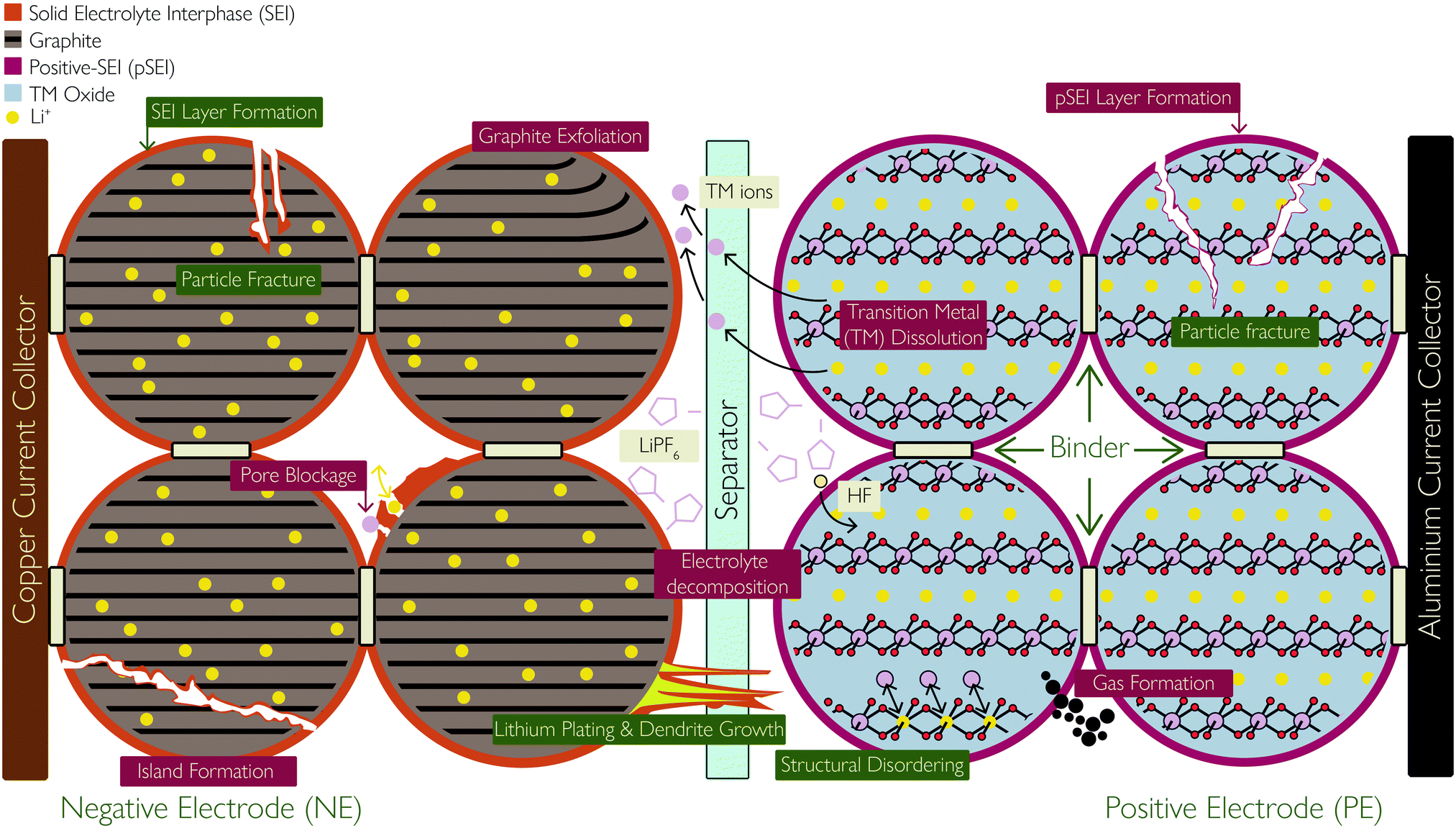


The decarbonization of transport and energy systems relies heavily on lithium-ion batteries, whose aging makes remaining useful life (RUL) estimation necessary to anticipate maintenance and replacement. This thesis proposes and compares two approaches. The first, model-free, fits the capacity with a third-order polynomial whose coefficients are re-estimated at each cycle through linearly constrained least squares. With low computational and data costs, it is well suited to embedded use (it uses data from the research group CALCE from the University of Maryland, USA). The second combines an electrochemical charge-discharge model with an aging model, jointly identified by an extended Kalman filter and then used to predict future degradation (using data from the Faraday Institution, UK). Compared with data-driven methods (RNN, LSTM), the polynomial approach achieves similar performance at a lower cost. The electrochemical approach offers better extrapolation and a physical interpretation of degradation, which highlights the complementarity of the two families of methods.