

The Challenge of Terahertz Imaging
The terahertz (THz) spectral domain is attracting growing interest across many fields, including non-destructive testing, industrial inspection, materials analysis, chemical detection, and biomedical imaging. Terahertz waves can penetrate many non-conductive materials such as polymers, ceramics, biological tissues, and certain pharmaceutical products.
However, THz imaging still faces significant limitations. Because of the long wavelengths associated with the terahertz domain, the resolution of conventional systems remains limited to the submillimeter scale. As a result, there is an unfavorable trade-off between the size of the observed field and the level of detail that can be resolved.
An Innovative Approach: Fourier Ptychography Applied to THz Imaging
To overcome this limitation, researchers have adapted an advanced computational imaging technique—Fourier ptychography—to the terahertz domain.
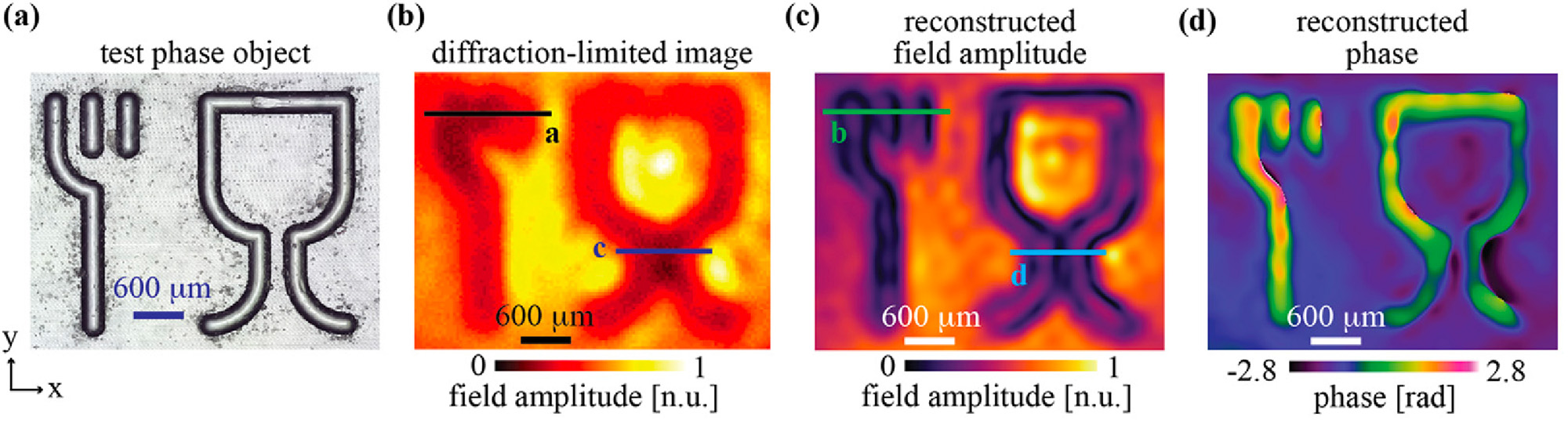
The principle consists of illuminating the sample from different angles using a motorized mirror that precisely controls the THz beam. Each captured image contains a shifted portion of the object’s spatial spectrum. All the acquisitions are then digitally reconstructed to synthesize a larger aperture and recover details beyond the classical diffraction limit.
This approach makes it possible to:
- significantly increase the recoverable spatial bandwidth;
- improve spatial resolution by nearly a factor of two;
- simultaneously obtain both amplitude and phase information;
- perform quantitative measurements on fine structures and complex materials.
The results demonstrate the system’s ability to reveal micrometric details that are invisible with conventional THz imaging.
New Opportunities for Industry and Healthcare
Beyond the experimental demonstration, this breakthrough opens concrete prospects for non-destructive inspection, material characterization, internal defect detection, and the analysis of opaque objects.
The entire acquisition and reconstruction process is now automated, with a processing time of approximately 90 seconds, demonstrating the practical feasibility of this approach for real-world applications.
International Recognition for French Research
The coverage of this work by Nature Photonics, a leading international journal in photonics, highlights both the scientific importance and the application potential of this research.
This international recognition also underscores the excellence of the work being carried out in computational imaging and terahertz technologies within laboratories affiliated with the CNRS (French National Centre for Scientific Research), such as the IMS Laboratory.
Detail
News and Views article in Nature Photonics
https://doi.org/10.1038/s41566-026-01903-5
Vasylchenkova, A. Fourier ptychography sharpens terahertz imaging. Nat. Photon. 20, 488 (2026).
Original article in Optica
https://doi.org/10.1364/OPTICA.586220
Pitambar Mukherjee, Vivek Kumar, Frederic Fauquet, Amaury Badon, Damien Bigourd, Kedar Khare, Sylvain Gigan, and Patrick Mounaix, “Terahertz Fourier ptychographic imaging,” Optica 13, 424-433 (2026)
Abstract
High-resolution imaging in the terahertz (THz) spectral range remains fundamentally constrained by the limited numerical apertures of currently existing state-of-the-art imagers, which restricts its applicability across many fields, such as imaging in complex media or non-destructive testing. To address this challenge, we introduce a proof-of-concept implementation of THz Fourier ptychographic imaging to enhance spatial resolution without requiring extensive hardware modifications. Our method employs a motorized kinematic mirror to generate a sequence of controlled, multi-angle plane-wave illuminations, with each resulting oblique-illumination intensity image encoding a limited portion of the spatial-frequency content of the target imaging sample. These measurements are combined in the Fourier domain using an aberration-corrected iterative phase-retrieval algorithm integrated with an efficient illumination calibration scheme, which enables the reconstruction of resolution-enhanced amplitude and phase images through the synthetic expansion of the effective numerical aperture. Our work establishes a robust framework for high-resolution THz imaging and paves the way for a wide array of applications in materials characterization, spectroscopy, and non-destructive evaluation.


