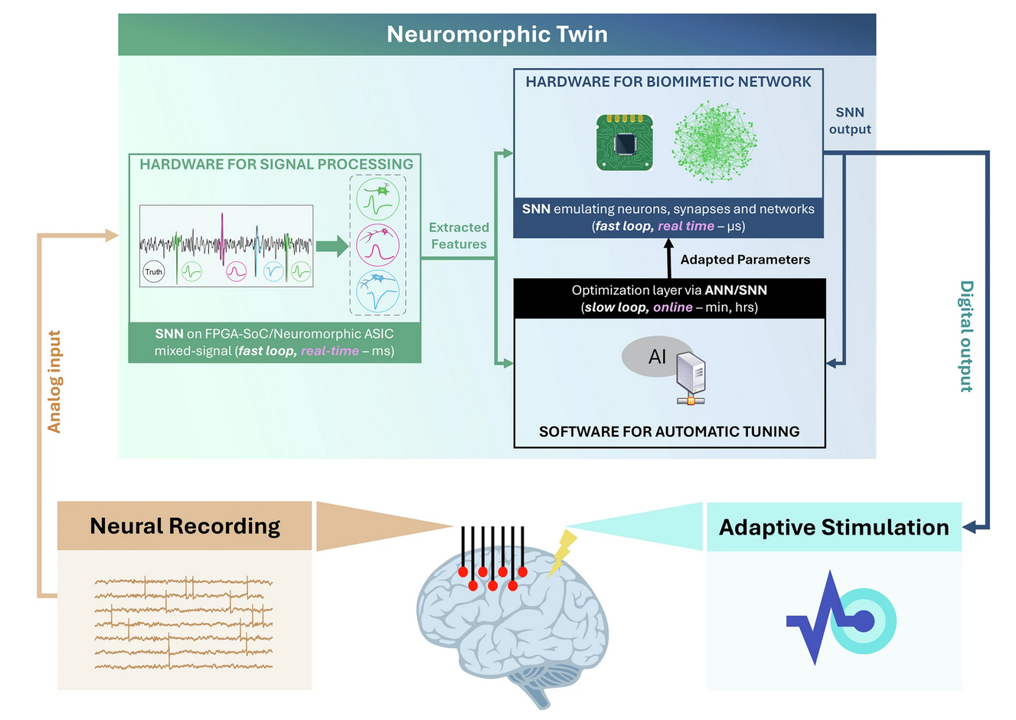


An innovative study published in Nature Communications, February 2026 (Vol. 17) highlights the remarkable potential of Neuromorphic Twins, which are digital real-time replicas of neural systems capable of emulating the brain’s adaptive and dynamic behavior, while also enabling the decoding and precise modulation of neural activity.
These new biomimetic Spiking Neural Networks (SNN) could help:
- advance fundamental brain research
- enable personalized electroceutical therapies for neurological disorders
- accelerate neuroengineering and brain repair technologies
- enhance cognitive functions through next-generation brain-machine interfaces
This study was conducted by Timothée Levi from the IMS Laboratory, University of Bordeaux, and Michela Chiappalone from the Department of Informatics, Bioengineering, Robotics, and Systems Engineering (DIBRIS), University of Genova.
This work is part of the NEUROHYSTIM project (funded by the PHC Galileo Project) and the BIONIC Project (funded by NATO Science for Peace and Security Programme).
Detail:
https://doi.org/10.1038/s41467-026-68923-1
Chiappalone, M., Levi, T. Advancing neuroengineering with Neuromorphic Twins. Nat Commun 17, 1938 (2026).
Abstract:
Neuromorphic engineering, originally focused on replicating the biophysics of neurons and synapses in hardware, has progressively expanded to explore novel computational principles, materials, and applications. With their unique ability to emulate brain functions, neuromorphic devices are emerging as prime candidates to advance the treatment of brain disorders, addressing the current limitations of electroceutical-based strategies, particularly their lack of flexibility and personalization. In this Perspective, we introduce and elaborate on the concept of the ‘Neuromorphic Twin’ and explain why this emerging technology is both timely and relevant. By integrating Digital Twin approaches for modelling the brain’s functions with neuromorphic engineering, Neuromorphic Twins offer the potential to address major challenges, such as dealing with brain complexity in real-time, enabling adaptive and personalized interventions, and tracking the progression of neurological diseases over time. Moreover, they can be embedded in low-power devices, thus marking a transformative shift in biomedical interventions and promising to open new frontiers for neuroengineering and brain repair.


