
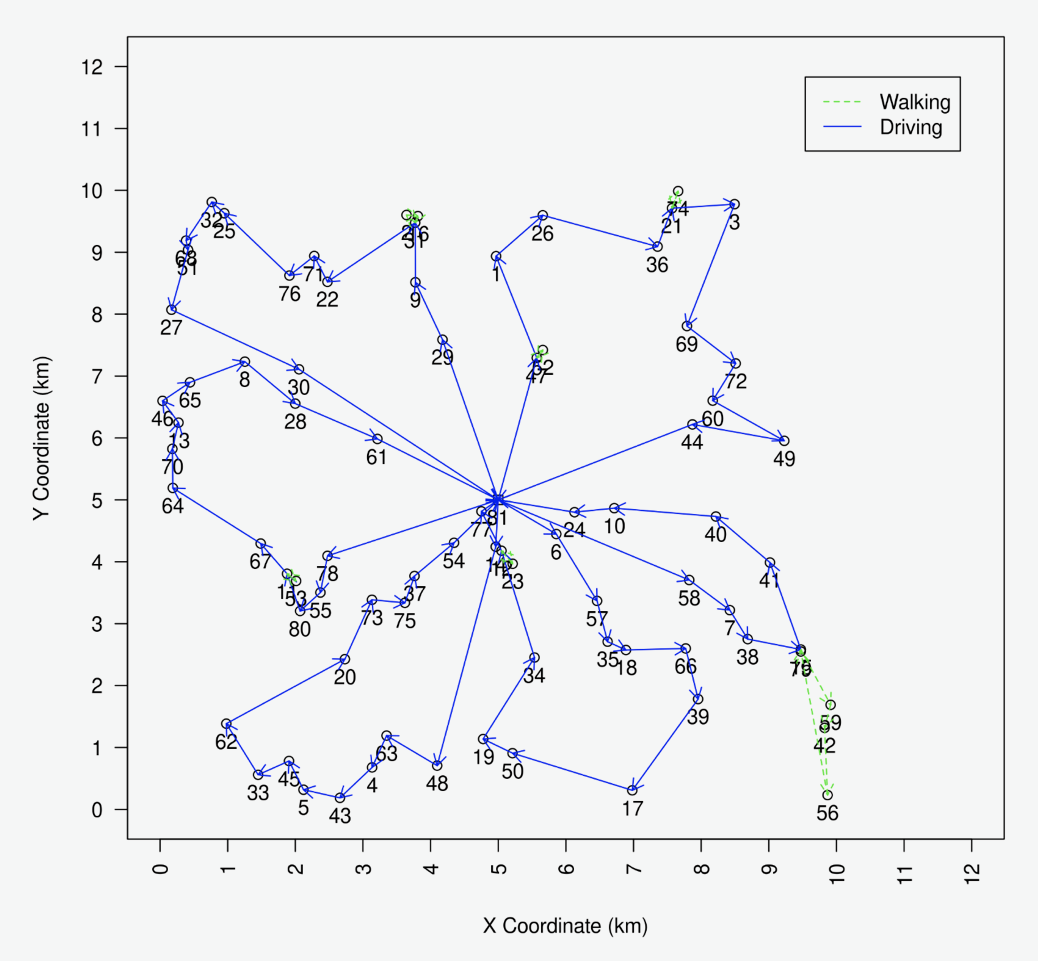
Drones represent a promising complement to delivery logistics. They offer a fundamentally different performance profile than conventional trucks. They have lower operating costs and higher speeds, at the expense of reduced range and capacity. In scenarios where these limitations are manageable, drones can fully replace traditional delivery trucks. However, in most practical applications, these complementary vehicle types should be strategically combined to leverage their respective operational strengths. We propose a new set-partitioning model for the Two-Echelon Vehicle Routing Problem with Drones, in which partial routes corresponding to drone movements are enumerated using a dynamic program. We also develop an exact branch-cut-and-price algorithm and a labeling algorithm to solve the pricing subproblem for the Truck-based Drone Delivery Routing Problem with Time Windows. Finally we study a variant of the Vehicle Routing Problem with Time Windows, which integrates two operationally relevant features: flexible departure times from the depot and strict limits on route duration. Although more generic, this problem can be assimilated to a drone routing problem in which the route duration limits the drone’s range. We develop an exact branch-cut-and-price algorithm that uses a bidirectional labeling algorithm for solving the complex pricing subproblem. We also show how the related problem of minimizing total route duration can be treated. Each algorithm is supported by extensive computational experiments.
News
THESIS DEFENSE of Sylvain LICHAU - February 4, 2026
Sylvain LICHAU will defend his thesis on February 4, 2026 at 2:00 pm in the amphitheater E of building A29, University of Bordeaux, on the subject: “Solving vehicle routing problems with drones in urban logistics: an approach based on exact and approximate optimization methods”.


